
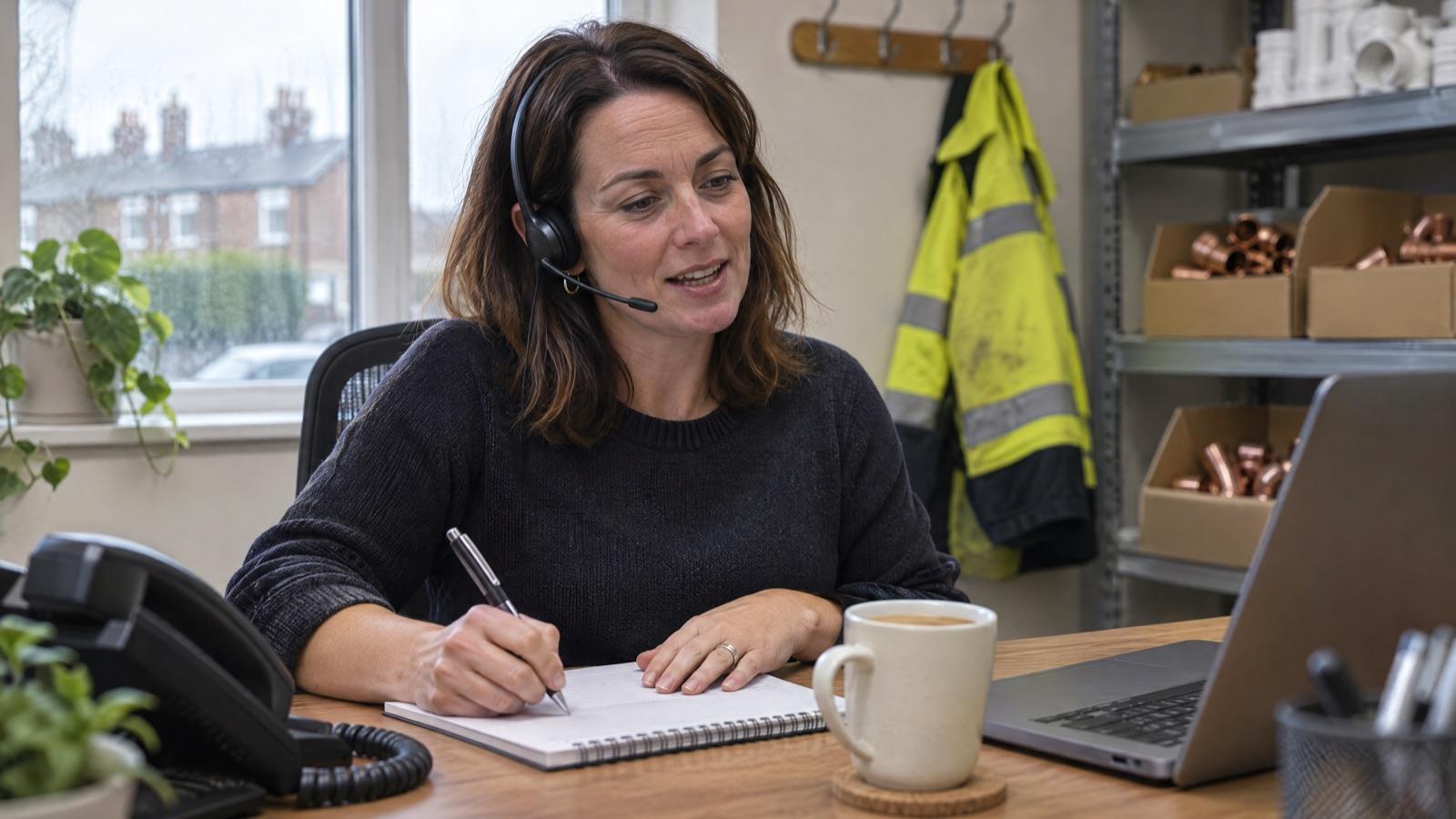
Calls alone rarely justify a full-time receptionist. At three minutes a call, even 30 calls a day fill well under half of one person's working day. What fills the rest is everything around the calls: booking customers into the diary, chasing enquiries and quotes, and answering the emails that arrive alongside. If you have under about 20 calls a day and little else, a pay-per-call answering service will almost certainly cost you less. If you have 30 or more calls plus bookings and follow-up that keep slipping, a dedicated person starts to make sense.
This guide shows the exact test we use, so you can run your own numbers before talking to anyone, including us. You can also put your figures straight into our two-minute workload check, which does the same sums and tells you which option is cheaper.
The fill-a-day test
The question is not "how many calls do we get?" It is "is there a full day's work here for one person?" A receptionist who is only busy for two hours a day is expensive however you employ them. A shared answering service or a pay-per-call plan exists for exactly that situation.
To answer it honestly you need five numbers for an average working day:
- C: customer calls a day (inbound calls that need a person, not spam or sales pitches);
- t: the average call length in minutes (if you don't know it, three minutes is a sensible starting point);
- B: bookings and changes a day (new appointments, reschedules, cancellations);
- F: enquiries or quotes to chase a day (follow-up calls or messages you should be making);
- E: customer emails a day that need a reply.
Your phone system's call log will give you C and usually t. Your diary or booking system gives you B. F and E are often the numbers nobody tracks, which is part of the point: they are the work that slips when the person answering the phone is also doing their real job.
The formula
We convert each task into minutes and add them up:
Workload (minutes a day) = C × (t + 1.5) + 5B + 6F + 3E
The allowances are planning assumptions, not industry standards, and you should change them if your work is different:
- 1.5 minutes per call for wrap-up: writing the note, updating the system, sending the message on;
- 5 minutes per booking to check availability, confirm details and send the confirmation;
- 6 minutes per follow-up, because chasing a quote usually means a call attempt, a voicemail or text, and a note;
- 3 minutes per email for a straightforward reply.
Then compare the total with what one person can realistically handle. A 7.5-hour day is 450 minutes, but nobody spends every minute on task: there are gaps between calls, breaks, training and the odd quiet spell. We assume 70% of the day is usable, which gives 315 productive minutes.
Fill = workload ÷ 315
How to read the result:
- Under 40% full: a pay-per-call answering service will cost you less. Don't hire a person for this.
- 40–70% full: borderline. A dedicated person is worth it only if you add the booking and follow-up work that is currently slipping.
- 70–130% full: a full day for one person.
- Over 130% full: more than one person's work. You are looking at two seats, or one seat plus an overflow service.
What pay-per-call would cost for the same calls
Shared telephone answering services usually charge in one of two ways: per call, or a small monthly fee plus a per-minute rate. To compare fairly, we use two typical UK price points that answering services published when we checked in October 2026:
- Per call: about 99p a call;
- Per minute: about £15 a month plus £1.20 a minute.
Prices vary by provider and change often, so treat these as benchmarks and get real quotes. With an average of 21.7 working days in a month (260 or so weekdays divided by 12), the monthly cost of answering your calls is roughly:
- Per-call plan: C × 21.7 × £0.99
- Per-minute plan: £15 + C × t × 21.7 × £1.20
Note that these figures cover answering only. Most pay-per-call plans take a message or transfer the call; booking into your diary, chasing quotes and replying to emails are either extra, limited or not offered. Check what is included before you compare.
Three worked examples
All three assume three-minute calls. For comparison, a dedicated receptionist and call handler from Cape Solutions costs £1,200–£1,600 a month for one named, full-time person working UK weekday hours, plus a one-off £1,500 setup. A UK employee costs considerably more once employer costs are added; our receptionist salary guide builds that figure up line by line.
10 calls a day: a sole trader or small practice
Say 10 calls, 2 bookings, 3 quotes to chase and 5 emails a day.
Workload = 10 × 4.5 + 5 × 2 + 6 × 3 + 3 × 5 = 45 + 10 + 18 + 15 = 88 minutes, which is 28% of a day.
Pay-per-call for the calls: about £215 a month per call, or £796 a month per minute.
Verdict: buy a pay-per-call service. A full-time person would sit idle for most of the day, and even the dearer pay-per-call option costs less than a dedicated seat. If the 10 calls are mostly bookings, look at whether online booking would take some of them off the phone altogether.
30 calls a day: a busy trades firm, clinic or showroom
Say 30 calls, 10 bookings, 12 quotes or enquiries to chase and 15 emails a day.
Workload = 30 × 4.5 + 5 × 10 + 6 × 12 + 3 × 15 = 135 + 50 + 72 + 45 = 302 minutes, which is 96% of a day.
Pay-per-call for the calls alone: about £644 a month per call, or £2,359 a month per minute.
Verdict: a full day for one person. Be honest about the comparison, though. On a 99p-per-call plan, the calls themselves are cheaper than a dedicated seat. The case for a person rests on the other 167 minutes: the 10 bookings, the 12 follow-ups and the 15 emails that a message-taking service won't do. If those matter to your revenue, one person who does all of it is the better buy. If they don't, the per-call plan wins.
The same business with calls only (30 calls and nothing else) comes out at 135 minutes, or 43% of a day. That is the borderline band, and it shows why call count on its own is the wrong test.
60 calls a day: a multi-chair practice or a firm with a big service area
Say 60 calls, 15 bookings, 10 follow-ups and 20 emails a day.
Workload = 60 × 4.5 + 5 × 15 + 6 × 10 + 3 × 20 = 270 + 75 + 60 + 60 = 465 minutes, which is 148% of a day.
Pay-per-call for the calls: about £1,289 a month per call, or £4,702 a month per minute.
Verdict: more than one person can do well. Either plan for two people, or one dedicated person with an overflow service behind them for the busiest hours. At this volume the per-minute plans become very expensive, and even the per-call plan costs about the same as a full-time seat while doing less.
Where the break-even sits
On call answering alone, using the benchmark prices above and three-minute calls:
| Pay-per-call plan | Costs more than a £1,200–£1,600 seat from about |
|---|---|
| £15 a month + £1.20 a minute | 15–20 calls a day |
| 99p a call | 56–74 calls a day |
Those are wide bands, and that is the honest answer. Against the cheapest per-call plans, calls alone almost never justify a dedicated person until you are into the high fifties a day. What changes the sum is the work a shared service doesn't do. If you are losing bookings because nobody rings back, or quotes go cold because nobody chases them, that work has a value that a per-call price doesn't capture.
Things the formula doesn't capture
The busiest hour
Averages hide peaks. If 40% of your calls arrive between 8am and 10am, one person will miss some of them however quiet the afternoon is. Look at calls in your busiest hour. If one person can't take them all, you need either a second line of cover for that window or a pay-per-call overflow.
Hours you need covered
A dedicated person works a normal working day. If what you really need is evenings, weekends or overnight cover, a 24/7 shared service is the right tool. We cover UK weekdays only, so if your problem is out-of-hours calls, we're not the answer.
Holidays and sickness
An employee is entitled to 5.6 weeks of paid holiday a year (GOV.UK, holiday entitlement), and somebody has to answer the phone while they are away. Whichever option you choose, ask how cover works when your person is off.
The value of a missed call
If one booking is worth £40, missing a few calls a week is a nuisance. If one job is worth £4,000, a single missed call can pay for a month of cover. Weigh the fill-a-day result against what a lost enquiry is worth to you, and read our guide to how fast to call back a web enquiry or quote if follow-up is where you are leaking.
How to use this
- Pull two typical weeks of call logs and count calls a day and average length.
- Count bookings, quotes awaiting a chase and customer emails for the same days.
- Run the formula, or enter the numbers in the workload check.
- If you are under 40%, buy a pay-per-call service and spend the difference elsewhere.
- If you are between 40% and 70%, list the booking and follow-up work that is slipping and add it in. If it pushes you over 70%, that work is the reason to hire.
- If you are over 70%, compare a UK hire, a dedicated remote person and a shared service on the whole job, not just the calls. Our receptionist cost comparison puts the three side by side.
Not sure what the different options actually are? Our explainer on what a virtual receptionist is covers shared answering services, AI answering and a dedicated remote person. And if you do have a full day of calls, bookings and follow-up, see how one person handles appointment booking and enquiry and quote follow-up alongside the phones.
The quickest next step is to run the workload check with your own numbers. It shows the pay-per-call price for your calls before it asks for anything, so you'll know straight away whether a person is worth talking about.
Frequently asked questions
How many calls a day justify a full-time receptionist?
On calls alone, usually more than you think. At three minutes a call plus wrap-up, 30 calls take about 135 minutes, under half of a realistic 315-minute working day. A full-time person makes sense when calls plus bookings, follow-ups and emails add up to 70% or more of that day. Use the workload check to test your own numbers.
When is a pay-per-call answering service cheaper?
When your workload fills less than about 40% of one person's day, or when you only need calls answered and messages taken. At typical UK prices of about 99p a call, calls alone stay cheaper than a £1,200–£1,600 dedicated seat until roughly 56–74 calls a day.
What does the 315-minute day mean?
It is a 7.5-hour working day (450 minutes) at 70% utilisation. Nobody spends every minute on task, so we plan on 315 productive minutes for one person. You can change the assumption if your experience is different.
Does a dedicated receptionist cover evenings and weekends?
Cape Solutions covers UK weekdays only. If most of your missed calls are in the evening or at weekends, a 24/7 shared answering service is the better fit.